Andy is in the air we breathe. Among the most revolutionary artists who ever lived, Warhol, in his work from the magical years of 1962 to 1964 — Coca-Cola bottles, Campbell’s soup cans, Brillo boxes, Marilyn, Jackie, Brando, Elvis, electric chairs, paint-by-number paintings, the fabulous dance-step diptych (once hung facing one another by Warhol, to be a couple), the Empire State Building film, flower paintings and superstars — gives us an artist in a state of creative grace feeding on, mirroring, doubling, and actually changing the culture he pictured. Willem de Kooning famously called him “a killer of beauty.” I think he invented a new beauty. Warhol was a philosophical assassin and vampiric social figure ever interested in and hyperobservant of the culture around him. He would sometimes not speak a word, ask an interviewer what he should say, and send body doubles to lecture for him. But that performance of fame was just one part of what he did, however much it dominates the memory of him outside the art world. At the Whitney’s new retrospective, you can look through all that to his art — its primitive hits of optical power, poisonously alive color that doubles as makeup and war paint, tragic glamour, coolness, heat, voyeurism, secret sexualities, bulletproof sincerity, visual originality, and brave refusal of and resistance to all pictorial norms.
It isn’t to be missed. Beautifully curated by Donna De Salvo, it allows viewers to take in an artist who, by the time he died at 58, was world famous — endorsing brands, starring as himself on TV — but was still shunned in the art world. He was thought of as overexposed and over-the-hill — someone Robert Hughes disdained as “abnormal,” “homosexual,” and “malevolent” in one sentence. As Warhol said, “All my reviews are bad.”
He also famously said that anyone who wants to know about his work only has to “look at the surface of my paintings.” Let’s do that.
1. Living Room, 1948
When he was 20 years old and a senior at Carnegie Institute of Technology majoring in “pictorial design,” Andrew Warhola painted a watercolor of the living room of his working-class Pittsburgh home at 3253 Dawson. Warhol was raised in the Depression, and he lived here with his two brothers; his mother, Julia; and father, Andrej. (His parents had emigrated from Czechoslovakia.) Living Room is a startlingly condensed, rich, incredibly well-observed and precociously complicated and bewitching picture that pulls us into its world. Think of this living room as Warhol’s van Gogh’s Bedroom — a weighing of some sort of ragged truth, one that pictures not the place we sleep (he made a whole film of that) but where we live, are social, and where our world takes place in private and public at the same time. It may be a beginner’s effort, but, knowing whom Warhol became, it’s an almost indispensable document of where he came from.
We see a worn, shabby still tidy 10-by-14-foot room with a run-down sofa and overstuffed maroon armchair — both covered in patterned fabrics and pillows for comfort and protection. The room is organized, full, almost modular in the way things look to be easily rearranged. Note the old wooden rocker, end table with a tilted lamp, a standing lamp also with tilted shade, the threadbare Oriental carpet on a wood floor and a solid brick fireplace. The only décor is the cross on the mantelpiece. Three beat-up window shades lowered unevenly round out this picture of a certain immigrant America.
It’s also the room where Warhol’s dead father was laid out for three days in 1942 after he died from drinking poisoned coal-mine water, according to Julia. The young Andy was too afraid to come downstairs to view the body. By then the boy had already had contracted St. Vitus’s dance (i.e., chorea), which made him shake and gave him skin blotches that lasted many years — and formed his obsession with the people he called “the beauties,” believing perhaps that his beauty would come from being around them. His sickness kept him out of school; he and his mother bonded even more. He’d only been friends with girls; boys ridiculed him.
While sick, Warhol endlessly cut out paper flowers, made decorations, played with dolls, and began a lifelong collection of autographed pictures of movie stars. Shirley Temple was his first favorite. His mother got cancer after his father died, had an operation, and wore a colostomy bag for the rest of her life, much of which she spent living with Andy, her adult son, in Manhattan; she moved out in 1971, a year before she died at age 81. Death always lurked on the margins of Warhol’s life.
There’s no outdoors pictured through the windows. Everything you need to know is right here. I love this dusky cluttered painting — and never saw it before this show!
2. Male Genitals, 1950s

Photo: The Andy Warhol Museum, Pittsburgh, Founding Collection, contribution The Andy Warhol Foundation for the Visual Arts, Inc./Courtesy of © The Andy Warhol Foundation for the Visual Arts, Inc./Artists Rights Society (ARS), New York
In June 1949 — after working in the display department of a Pittsburgh department store, where he’d show up with fingernails painted different colors and shoes dyed odd colors, Warhol, still 20 and now a Carnegie graduate, boarded a train to New York with his artist friend Philip Pearlstein. In one of those fabulous New York stories, on his second day in the city he went to see Tina Fredericks, art director of Glamour magazine. Not only did she buy one of his drawings for $10, she told him, “I need some drawings of shoes, Mr. Warhola … tomorrow morning at 10 a.m. Can you do them?” He loved feet and shoes and fashion and deadlines and could draw anything.
Look closely at the work in this show from this period. These years are often dismissed as Warhol’s juvenilia, his commercial years, but almost everything he’d do for the rest of his life surfaced in that decade. There are pictures of people sleeping, advertising images, portraits of the famous and portraits of freaks, drawings of shoes. They are dedicated to Elvis, Mae West, and Christine Jorgensen — a man who became a woman who became a successful cabaret artist. There are images of money, soup cans, men in jeans, car crashes, flowers, newspaper headlines, and endless drawings of the male body in all states of dress, undress, relaxation, and having sex. Scores of drawings of penises too. As Pearlstein rightly put it, all “totally unacceptable” subjects in the art world of that time. So if you want the political revolutionary, look no further.
There’s more though. In the ’50s, Warhol found the prototype of his own future factories. This was the wild 58th Street studio of fashion photographer Otto Fenn — who always had an assortment of strange, beautiful, and famous creatures around him. It was this underground gay scene that Andy thrived in and was nurtured by. Not the “straight” art world of the Abstract Expressionists or the new scenes around Jasper Johns, Robert Rauschenberg, Cy Twombly, Merce Cunningham, and John Cage. His “outness” made Warhol an outsider to all this. Wayne Koestenbaum writes, “How gay was Warhol? As gay as you can get.” He goes on to say that for “Warhol, everything is sexual … Movement is sexual. Stillness is sexual. Looking and being looked at are sexual. Time is sexual.” Warhol’s sexuality — however we may define the term — was even deeper than mere voyeurism; it’s simultaneously observer, participant, wallflower, cannibal, agent provocateur, and lover.
Warhol learned from Fenn and soon began holding “coloring parties,” where people would come over to color his work or to help make it. His mother signed his name to works. It was here that he’d regularly ask any male visitor to his studio to draw his penis. Andy liked to look. As many have reported, sometimes he’d become turned on and flustered while making these drawings and retire to the bathroom to have what he called a “private organza.” So beautiful. Here, a direct, disarming, sweet, strange, suggestive mode of loving, laughter, need, reticence, and immense focus doubles male genitals as cake candle, gift wrapped, tied in a pretty bow, and decorated with hearts and flowers. All with Matissean flair, assuredness, and simplicity. Note nearby drawings of penises wrapped in bows and decorated with pansies, or a penis placed on a plate with a fork checking plumpness, and naked men holding cats — what Warhol always called “pussies.”
By the early 1960s, he had taken the a off his last name to remove any Slovak associations, had a nose job, took to wearing a glued-on wig, and mounted shows of his so-called illustration and commercial work. Though he had arrived in New York with only $200, and slept for years with his mother next to him on a mattress on the floor, and lived sometimes with dozens of cats, by 1959 Warhol was so successful that he paid $67,000 for a townhouse at 1342 Lexington Avenue. He continued to live with Julia for decades.
3. Marilyn Diptych, 1962

Photo: Tate, London/Courtesy of © The Andy Warhol Foundation for the Visual Arts, Inc./Artists Rights Society (ARS), New York
The work of 1960s is what Warhol is most known for. The bulk of the catalogue is devoted to this concentrated ten-year outpouring. As radical as this work might appear now, Warhol didn’t invent pop; he picked up on the trend after many, many others had. He was called derivative of artists like Rosenquist and Oldenburg, a lightweight compared to Johns, a latecomer for appearing after Lichtenstein. Nevertheless, he was an insurrectionary, though it is true that an often-breathless hagiography surrounds him. Worse, his art is at the center of an inflated market, and every rich person and would-be collector wants to share in Warhol’s coolness by buying a piece of it.
But to appreciate just how original he is, here is an essential exercise for looking at Warhol’s work at the Whitney: First, identify the subject matter, be it Liz, Jackie, Natalie Wood, Liza, Mick, Dennis Hopper, a car crash, suicide, over 630 sunsets, Mona Lisa, flowers, Dick Tracy, Superman, criminals, the telegram announcing JFK’s death, hammers and sickles, or Andy’s face. Second, set aside the subject matter for a while or, rather, look through it to only how Warhol paints. Just this. The first thing you will notice is his color. It’s electric, psychedelic, vibrating, merging; it clashes, flips, and flickers. He’s also prone to monochrome that doesn’t read as only gravitas and serious (as in formalist painting) but something more aggressive, contradictory, “problematized.” What are these colors? As with Pollock’s drip — which was there in the caves but never really picked up on until the drip paintings — Warhol’s colors have been with us for millennia. It’s just that no one ever combined them this way in the history of art. Or anywhere, really. It’s like finding another note on the saxophone. This note has since been used to create whole visual cultures. With color, he is a rival to van Gogh and Matisse.
There’s more. Note how he uses the silk-screen. It isn’t his choice of so-called low subjects for art. It isn’t that he painted photographic images. It isn’t even his serial, gridded, repeating images. What gives Warhol’s work its singularly yelping optical intensity is how his screens smudge, skid, streak, aren’t on register, get overloaded, are off center and out of alignment. This turns still and repeating images into quixotic filmic experiences, gives changing retinal reads, and makes seeing and deciphering them trickier, mysterious, even after you glean the subject. What’s pictured and how he pictures it fuses (like in Monet or Seurat, for example); you can’t see one without the other. Moreover, you’re not just seeing repeating images out of register: Warhol leaves in the graininess of the original photographic images. This reminds you that these paintings are removed from the original sources, that they come from somewhere else. The degrading of the silk-screen makes the process even more ever present. And strange. Warhol is showing us that the way we usually respond to repeating images — like advertisements, Coke cans, celebrities, the news — is to see these things and then stop seeing them. They all almost blend in and begin to go unnoticed. Warhol continually pulls you back to the image, the thing, its source, what it is, how it’s been deployed, and the way it’s been rendered. This is as big as La Grande Jatte.
For real spice, add that the primary “paintbrushes” he used to make this work were the bodies of others — his assistants, always male, often shirtless, muscular, and sweaty because screens are heavy. Andy would stand to the side and “direct” them.
This last “spice” is important, as the entire history of Western painting had always rested on the artist’s hand — the artist’s skill with paint and the brush. But Warhol forwent such institutional and historical approval. He made his pictures without any connection to traditional uses of paint, tools, materials, surfaces, subject matter, or even photography. This takes us back to Koestenbaum’s “as gay as you can get.” Not only did Warhol wear makeup, pantyhose under his jeans, a wig, and pose regularly in drag, he didn’t claim any traditional, approved way to make art. And he felt other gay artists didn’t like him because he was “too swish.” Victor Bockris quotes someone in his Warhol biography: “Here was this weird cooley little faggot with his impossible wig … it was embarrassing. Didn’t he know that he was a creep?” If you know nothing else about Warhol, if you look at none of his work, just know that this “creep” way of making what he made is as revolutionary as it gets.
Marilyn Diptych may be Warhol’s American Flag. The 50 repeating Marilyns are the stars in his flag. The picture is from Monroe’s first starring role, in Niagara, and is the only still he ever used of her. “When Marilyn Monroe happened to die that month (August 5, 1962) I got the idea to make silk-screens of that beautiful face,” he coolly said. Here, the Marilyns mirror one another. Half the painting is vibrant contrasting color. The other half — after she’s dead — turns ghostly black, gray, and white. The colored half is perfect; the other half is filled with smudges and gluts. Paint sluices over one row, almost blotting out this star. Monroe, with Liz and Jackie, are Warhol’s beautiful, tragic trinity of heroines. There’s Jackie so young and lovely in the White House, so stunned by grief after the assassination. Liz, drug-addled divorcée, the eventual warrior queen of AIDs. And Marilyn, probable American suicide at 36. In another one of the odd prefigurations that mark Warhol’s life, in 1964 self-styled witch and Factory character Dorothy Podber put on a pair of white gloves, produced a pistol, aimed it at a stack of Marilyn paintings, and shot through four of them. It’s said that when the paintings were exhibited, the holes were painted over with makeup and the portraits titled “Shot Marilyn.” Warhol used everything.
4. Mustard Race Riot, 1963

Photo: Museum Brandhorst, Munich/Courtesy of © The Andy Warhol Foundation for the Visual Arts, Inc./Artists Rights Society (ARS), New York
People have complained that Warhol wasn’t political. I disagree. I’ve called Warhol revolutionary for changing the way the world looks and the way we look at the world. But Warhol was political in other ways. And not only as a swish gay man who openly used amphetamines and celebrated queer sex and sexuality. Warhol may have voted only once, but he noticed things and then painted what he noticed. He noticed with a vengeance and never stopped at just noticing. He made charged, confrontational pictures of gay icons, communists, capital punishment, cross-dressers, beefcake, penises, semen paintings made with semen, abstractions made by urinating and having others urinate on canvases, headlines about Harlem stabbings, Lenin, the FBI’s 13 most-wanted men (which officials had removed from a World’s Fair pavilion; Warhol and his assistants surreptitiously painted over the mural with silver paint, leaving it that way), hammers and sickles (some with vibrators), guns, and Mao. He also painted among the greatest so-called protest paintings ever made. Vote McGovern, 1972, raised $40,000 for the George McGovern presidential campaign. It is an ugly picture of Nixon with a yellow mouth, blue jowls, green upper face — a president as a Goya-like gargoyle. Warhol aficionado extraordinaire Henry Geldzahler declared the work as “loathsome … a latter-day disaster painting.” After this portrait, Warhol (as well as other artists involved with the McGovern campaign, including Rauschenberg, Terry Southern, and Norman Mailer) was audited by the IRS. He was audited thereafter until he died.
An example of Warhol noticing and painting what he noticed is Mustard Race Riot, a powerful almost-gold silk-screen showing police with dogs beating black protesters. The right side — the all-mustard-color part (he’s always telling you things you might not notice?) — hits you with flat, blank monochrome undeniability and leaves a sickening political taste in your mouth. Another kind of flag painting.
5. Cow Wallpaper and Silver Clouds, April 1966

Photo: Rudy Burckhardt/Archives of American Art, Smithsonian institution, Washington, D.C./Courtesy of © The Andy Warhol Foundation for the Visual Arts, Inc./Artists Rights Society (ARS), New York

Photo: Rudy Burckhardt/Archives of American Art, Smithsonian institution, Washington, D.C./Courtesy of © The Andy Warhol Foundation for the Visual Arts, Inc./Artists Rights Society (ARS), New York
In April 1966, Warhol celebrated his “retirement from painting” with an exhibition at Leo Castelli Gallery by covering one room in pink, yellow, and black cow wallpaper and in the other room placing free-floating silver helium-filled pillows called “Clouds” (originally created as set design for Merce Cunningham’s “Rain Forest”). The allover installation/happening was his “farewell to art.” Warhol also declared Pop Art “dead” and went all in on what he’d been doing for the last few years anyway: making films. These feature some of his pixilated hangers-on, oddballs, acolytes, and outsiders like Viva, Ultra Violet, Sugar Plum Fairy, Holly Woodlawn, Edie Sedgwick, “Little Joe” Dallesandro, Taylor Mead, Ondine, Ingrid Superstar, John Giorno, and others. Mostly very little happens in Warhol’s movies or so much that it turns into a monumental immersion in otherness. These include Blow Job, Hand Job, Sleep, Chelsea Girls and, perhaps most famous of all, Empire. This masterpiece was filmed starting at 6 p.m. from the 44th floor of the Time Life Building. Warhol framed the shot. Filmmaker Jonas Mekas and assistant Gerard Malanga changed the film rolls every 30 minutes. The crew stopped filming around 1 a.m. The first two rolls are overexposed because Andy set the exposure wrong. No matter, Warhol called the whole thing “an eight-hour hard-on. It’s so beautiful. The lights come on and the stars come out and it sways.” As with his other movies, Empire is shown at silent speed so that it lasts longer than it took to make — another typically Warholian way of manipulating time.
6. Big Electric Chair, 1967-68

Photo: The Menil Collection, Houston/Courtesy of © The Andy Warhol Foundation for the Visual Arts, Inc./Artists Rights Society (ARS), New York
This is one of the last works Warhol completed before Monday, June 3, 1968. It is a jarring, chilling hard-to-read image, almost abstract, masterful, optically complicated, emotionally alienating, a cipher, a constellation unto itself, malevolent, flaglike. Nothing was the same for Warhol afterward.
That June day began like most other days for Warhol. He awoke uptown, prayed with his mother in the basement, shopped at Bloomingdale’s, and procured more Obetrol — an amphetamine in wide use as a diet aid. At 4:15 p.m., Warhol got out of a cab in front of his 33 Union Square West studio. (Dallesandro claimed to Alec Baldwin that it was also his first official day working at the Factory.) His boyfriend, Jed Johnson, was walking up to the door at the same time. They got into the elevator and were joined by Warhol hanger-on Valerie Solanas (who had appeared in his 1967 films Bikeboy and I, a Man). She had been to the Factory earlier that day looking for Warhol, was told he wasn’t there, so had waited downstairs, down the street. Watching. The three rode up in the elevator. Warhol noticed that she was wearing a heavy coat in this hot weather and was tightly clutching a paper bag. Inside, studio manager Fred Hughes was at his desk. Filmmaker Paul Morrissey was on the phone to Viva, who was having her hair done uptown at Kenneth’s Hair Salon. Also there was curator Mario Amaya. Johnson went into a side office. Morrissey handed off Viva to Andy, who then handed the phone off to Hughes and went in the back to the bathroom.
Just then, Solanos pulled a .32 automatic pistol from the paper bag. She raised the gun and pointed it at Warhol who was directly in front of her. He screamed, “No! No! Valerie! Don’t do it.” She fired two shots. Andy fell to the floor and tried to crawl under a desk. She walked toward him, pointed the gun and fired again. The third bullet entered Andy’s right side, exited through his back, leaving a huge wound. His lungs had been punctured; he couldn’t breathe. He later said he felt a “horrible, horrible pain, as if a firecracker had exploded inside me.” Solanos, thinking he was dead, walked toward Amaya, fired, and missed. Amaya ran away, but a fifth shot hit him in his flank as he did so. He crashed into the back room, where Billy Name was developing film, and with Morrissey, the three held the door so she could not get in. Thinking the door was locked, she returned to the office, stood in front of Hughes, and said, “I have to shoot you.” He fell to his knees pleading, “Please don’t shoot me, Valerie. You can’t. I’m innocent. I didn’t do anything to you. Just leave.” She pointed the gun between his eyes and pulled the trigger. The gun jammed. Just then, the elevator doors opened. Hughes screamed, “There’s the elevator, Valerie. Just take it!” She did and left.
On the floor, Warhol was dying. He was passing in and out of consciousness. Billy cradled Andy’s head in his lap and started to wail. Andy said, “Oh, please don’t make me laugh, Billy … please, it hurts too much.” Name said, “I’m not laughing, Andy … I’m crying.” At 4:35, 15 minutes after it began, an EMS team arrived and put Warhol on a stretcher. The stretcher wouldn’t fit in the elevator, so Warhol had to be carried, seated, in their arms, down the steep, dark flights of stairs. It was agonizing pain. He lost consciousness. At 4:45, Warhol was brought into the Columbus Hospital ER, where Dr. Giuseppe Rossi and a team began working on him. Amaya was in the bed next to him. He heard the doctors say that the pulse was faint. His wounds were devastating; the bullet penetrated his esophagus, liver, spleen, intestines, and — fatefully — his gallbladder. Then the doctor said, “Forget it” and that there was “no chance.” At 4:51 p.m., Warhol was pronounced clinically dead. Amaya screamed, “Don’t you know who this is? It’s Andy Warhol. He’s famous. And he’s rich. He can afford to pay for an operation. For Christ’s sake, do something.” They resumed work, massaging his heart as they did so. He revived.
Police detectives searched the factory, scoffing and disapproving of all the male porn and death-and-disaster paintings. They brought Hughes and Johnson into custody as suspects. Malanga rushed uptown to Warhol’s mother, who was about to hear of “me Andy” being shot on the radio. At 8 p.m., Solanas walked up to a 22-year-old rookie cop in Times Square and said, “The police are looking for me.” She handed him her gun and said she had to shoot Warhol “because he had too much control over my life.” The National Organization for Women (NOW) soon declared her “the first outstanding champion of women’s rights.” Robert Kennedy was shot and killed the next night. The ’60s ended many times. These two nights are among them.
Warhol wore tight surgical binders for the rest of his life. He later said “Before I was shot, I always suspected I was watching TV instead of living life. Right when I was being shot I knew I was watching television. Since I was shot everything is such a dream to me. I don’t know whether or not I’m really alive — whether I died. It’s sad.” It is.
7. Ladies and Gentlemen (Marsha P. Johnson), 1975
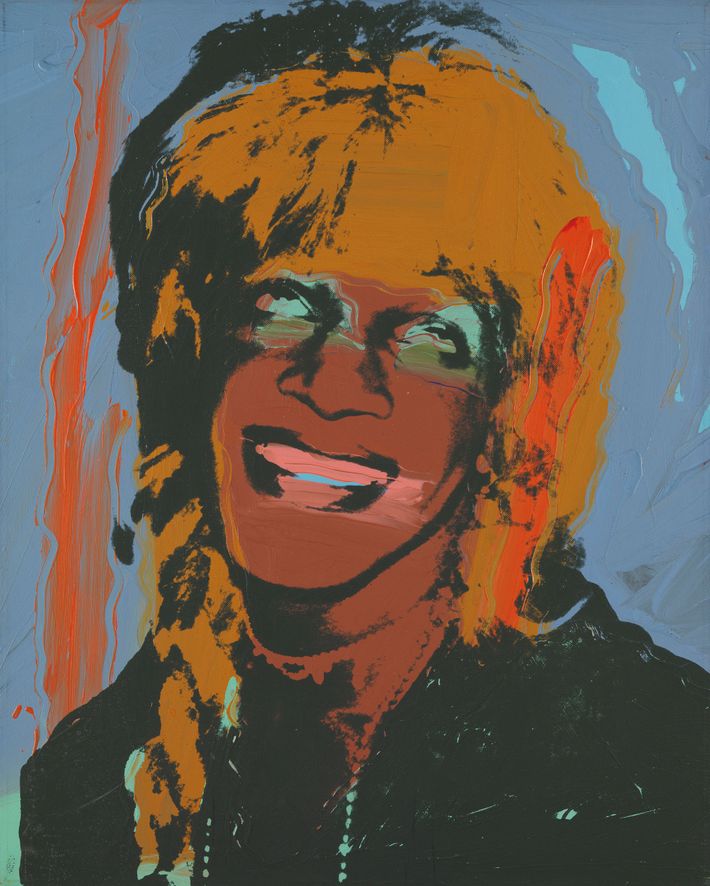
Photo: Museum Brandhorst, Munich/Courtesy of © The Andy Warhol Foundation for the Visual Arts, Inc./Artists Rights Society (ARS), New York
At the Whitney, the show drops off after the gigantic 1973 Mao. But what optical information is on offer still buzzes the mind. When Warhol returned to painting, it was by commencing his endless series of commissioned portraits. No one knows how many he painted. He saw it as an overall portrait of society. It’s said the going rate for commissioning one was $25,000. The format was almost always the same. Starting with a Polaroid taken by the Big Shot camera, which is only in focus at 40 inches, and for which Warhol always used a flash, as many as 50 pictures would be taken. One was then selected and rephotographed with a 35-mm. camera, transferred to acetate to silk-screen and then printed, always at the same 40-by-40-inches, to preserve the Polaroid framing. Warhol would sometimes subject them to his own “kind of plastic surgery,” bringing features out or collaging elements in. This endless series includes Muhammad Ali, Brigitte Bardot, Sylvester Stallone, Princess Di, Aretha Franklin, Gianni Versace, Jimmy Carter, Carly Simon, Martha Graham, unknown businessmen and society women, and O.J. Simpson. The work was panned as “shallow” and “boring” by the Times’ Hilton Kramer, while in Time, Robert Hughes said they “hardly exist within the sphere of aesthetic debate.”
One 1975 series stands out: Ladies and Gentlemen — a set of drag queens, each of whom was paid $50 to sit for a photo session—particularly the portrait Marsha P. Johnson, a black drag queen with pink teeth, blond hair in a twist, a beaded necklace, and a red streak down the right side of her hair, who has beautiful milk-chocolate-brown skin. Warhol probably never knew it but, as artist Glenn Ligon notes in a brilliant essay on the series in the show’s superb catalogue, Johnson was “already a star.”
On June 28, 1969, Johnson threw “the shot glass that was heard around the world.” She was, Ligon writes, “an integral part of the uprising that followed a police raid at the Stonewall Inn … having thrown a shot glass into a mirror … while shouting ‘I got my civil rights.’” She went on to be an activist in the fight for transgender rights. By her own estimation, “Black Marsha,” as she called herself, she had been arrested “over 100 times” for sex work. She’d been living on the streets. The P. in her middle name, she said, stood for “Pay it no mind.” She had nervous breakdowns, walked naked on Christopher Street. Shortly after the 1992 Gay Pride Parade, her body was found in the Hudson River. Police ruled the death a suicide. She had a massive wound in the back of her head. In 2012, activist Mariah Lopez got the NYPD to reopen the case as a possible homicide. That same year, a wonderful documentary, Pay It No Mind: Marsha P. Johnson, was made about her life. 2017 saw another film, The Death and Life of Marsha P. Johnson. RuPaul calls her “the true Drag Mother” who “paved the way for all.” Now look at all the Ladies and Gentlemen paintings again.
8. AIDS, Jeep, Bicycle, 1985-86
(This work is featured as a double-page full-color spread in the catalogue only.)

Photo: Pinakothek der Moderne, Munich/Courtesy of © The Andy Warhol Foundation for the Visual Arts, Inc./Artists Rights Society (ARS), New York
Another criticism against Warhol is that he supposedly ignored AIDS. In fact AIDS struck often and close to Andy; he knew many who died of the disease. The ramp-up to this was slow and terrifying. A 1981 New York Times headline “Rare Cancer Seen in 41 Homosexuals” was followed the next year by “New Homosexual Disorder Worries Health Officials.” You know the rest. In 1984, his boyfriend of several years — Jon Gould, whom he photographed more than 400 times — was diagnosed with AIDS. He was hospitalized that year, twice. Two years later, Gould was dead from the disease; he weighed 70 pounds and was blind.
AIDS is everywhere in Warhol’s last work. In paintings of words like “666 the Mark of the Beast,” “Are You Different?,” “Heaven and Hell Are Just One Breath Away,” “Repent and Sin No More.” In a Last Supper painting, he silk-screens the words “The Big C” under Christ. The C stands for cancer, as attested in Warhol’s source material. He drew a blank Reagan under a blank American flag. One of his last paintings just comes out and says it, however.
Along the whole bottom left side of the enormous canvas, stenciled and painted in patchy black, is the word AIDS. Above it, you can make out the sort of scare headlines that the New York Post used to regularly run and that helped stigmatize the disease and spread hatred of gay men. The words “New York Post” are partially seen as is the date “Friday August 30 1985.” To show how the culture was looking away, all this is somehow offset by images of a Jeep, a bicycle, seemingly from ads, and other letters. Like I said, Warhol noticed with a vengeance.
Rock Hudson died of AIDS that year. Mario Amaya, who had pleaded with the doctors not to give up on Andy after Solanas had shot them both, died of AIDS the following year. ACT UP was founded the year after that.
On Saturday, February 14, 1987, Warhol complained of abdominal pain to his dermatologist. He spent the weekend in bed, not telling friends what was going on. On Tuesday, he kept an appointment so he could be photographed with Miles Davis. That same day, he told another doctor he’d been feeling ill for four weeks. The doctor diagnosed him with an acutely infected gallbladder and advised that it be removed as soon as possible. Warhol waited two more days to see what would happen. On Thursday, he caught a chill. The gallbladder had become severely inflamed with fluid and had to be removed at once. He went to New York Hospital, was scheduled for surgery on Saturday. He said, “Oh, I’m not going to make it” and locked many of his valuables in his safe. After surgery, he was administered Cefoxitin — a drug very similar to penicillin, which he was allergic to; staff nurses failed to properly measure his fluids; a malfunctioning suction device that permitted the reduction in fluids was not replaced. Biographer Victor Bockris writes, “The chances of dying from complications of routine gallbladder surgery are thousands to one.” Andy Warhol died at 6:31 a.m. early Sunday morning, February 22, 1987.
Andy Warhol — From A to B and Back Again is at the Whitney from November 12 to March 31.
Another criticism against Warhol is that he supposedly ignored AIDS. In fact AIDS struck often and close to Andy; he knew many who died of the disease. The ramp-up to this was slow and terrifying. A 1981 New York Times headline “Rare Cancer Seen in 41 Homosexuals” was followed the next year by “New Homosexual Disorder Worries Health Officials.” You know the rest. In 1984, his boyfriend of several years — Jon Gould, whom he photographed more than 400 times — was diagnosed with AIDS. He was hospitalized that year, twice. Two years later, Gould was dead from the disease; he weighed 70 pounds and was blind.
AIDS is everywhere in Warhol’s last work. In paintings of words like “666 the Mark of the Beast,” “Are You Different?,” “Heaven and Hell Are Just One Breath Away,” “Repent and Sin No More.” In a Last Supper painting, he silk-screens the words “The Big C” under Christ. The C stands for cancer, as attested in Warhol’s source material. He drew a blank Reagan under a blank American flag. One of his last paintings just comes out and says it, however.
Along the whole bottom left side of the enormous canvas, stenciled and painted in patchy black, is the word AIDS. Above it, you can make out the sort of scare headlines that the New York Post used to regularly run and that helped stigmatize the disease and spread hatred of gay men. The words “New York Post” are partially seen as is the date “Friday August 30 1985.” To show how the culture was looking away, all this is somehow offset by images of a Jeep, a bicycle, seemingly from ads, and other letters. Like I said, Warhol noticed with a vengeance.
Rock Hudson died of AIDS that year. Mario Amaya, who had pleaded with the doctors not to give up on Andy after Solanas had shot them both, died of AIDS the following year. ACT UP was founded the year after that.
On Saturday, February 14, 1987, Warhol complained of abdominal pain to his dermatologist. He spent the weekend in bed, not telling friends what was going on. On Tuesday, he kept an appointment so he could be photographed with Miles Davis. That same day, he told another doctor he’d been feeling ill for four weeks. The doctor diagnosed him with an acutely infected gallbladder and advised that it be removed as soon as possible. Warhol waited two more days to see what would happen. On Thursday, he caught a chill. The gallbladder had become severely inflamed with fluid and had to be removed at once. He went to New York Hospital, was scheduled for surgery on Saturday. He said, “Oh, I’m not going to make it” and locked many of his valuables in his safe. After surgery, he was administered Cefoxitin — a drug very similar to penicillin, which he was allergic to; staff nurses failed to properly measure his fluids; a malfunctioning suction device that permitted the reduction in fluids was not replaced. Biographer Victor Bockris writes, “The chances of dying from complications of routine gallbladder surgery are thousands to one.” Andy Warhol died at 6:31 a.m. early Sunday morning, February 22, 1987.
Andy Warhol — From A to B and Back Again is at the Whitney from November 12 to March 31.